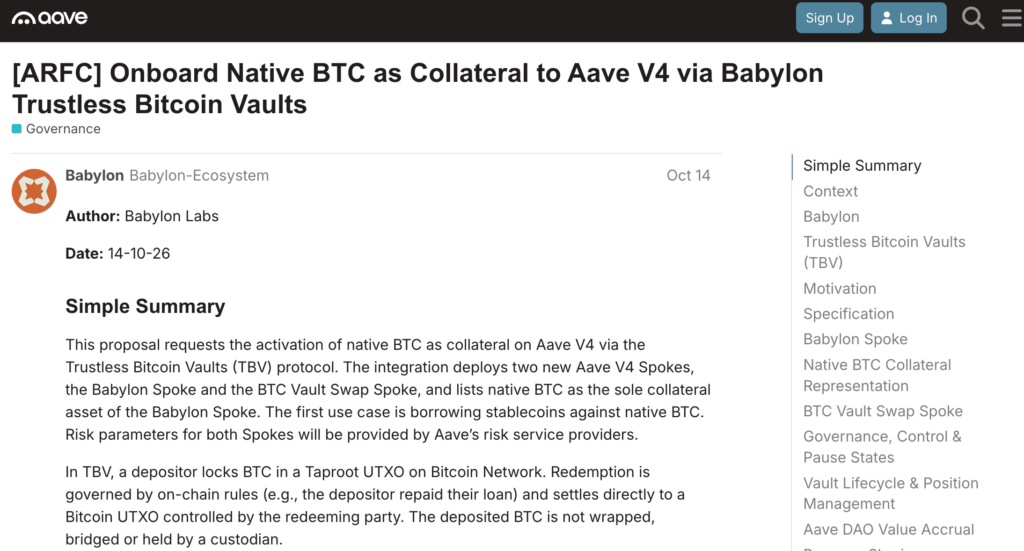
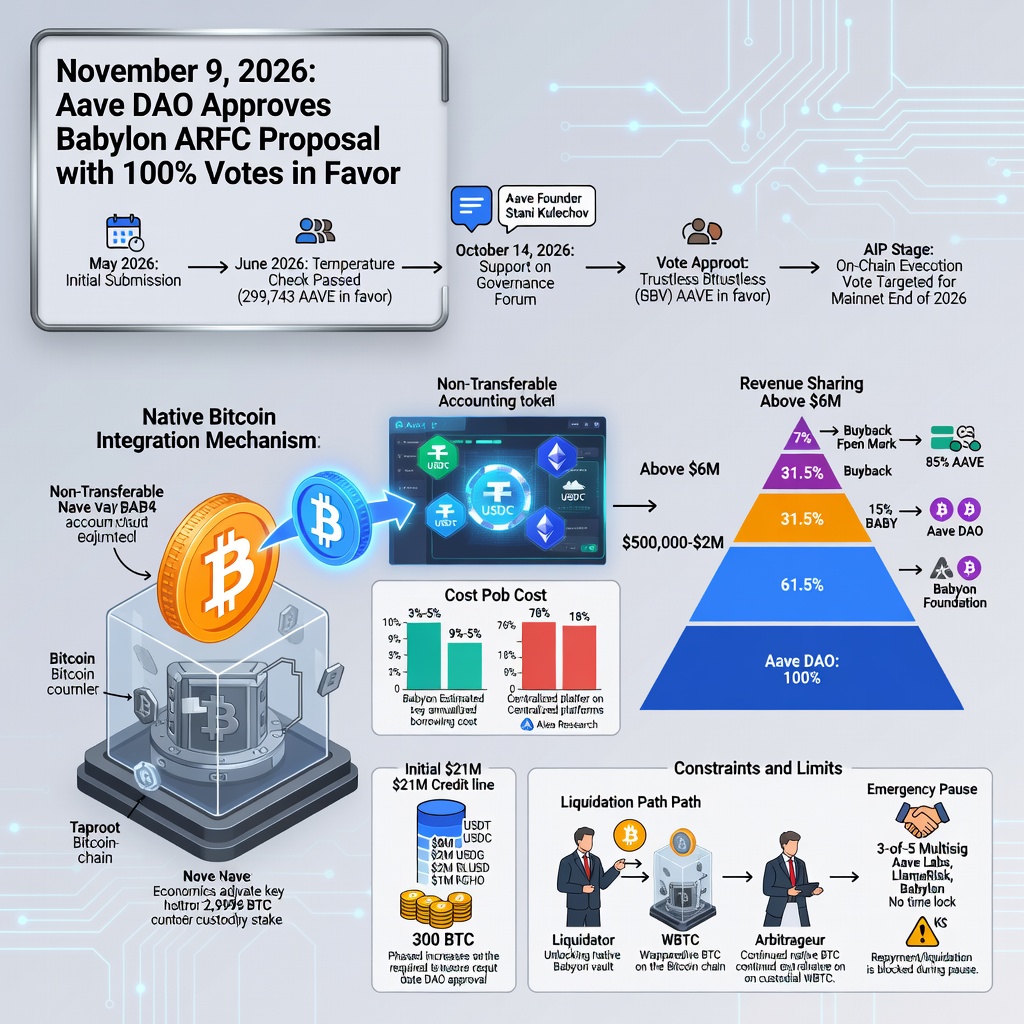
On November 9, 2026, the Aave DAO passed Babylon’s ARFC proposal with 100% of votes in favor, according to a Babylon post on X that day and a TechFlow report by 库里 published on November 10, 2026. The proposal would let holders lock native bitcoin in Babylon’s “trustless Bitcoin vaults” (TBV) and borrow assets such as USDT and USDC on Aave V4 without wrapping the bitcoin, bridging it, or handing it to a third-party custodian. The stated collateral ratio is 78%. The integration was not live in that report: the proposal still had to enter the AIP, described as the final on-chain execution vote, with mainnet targeted for the end of 2026. Participation and size would be limited at first and opened in stages.
How the proposal reached the November 9 vote
The proposal was first submitted in May 2026 and passed a community temperature check in June 2026, with 299,743 AAVE in favor and none against. Aave founder Stani Kulechov stated support on the governance forum on October 14, 2026, the day the formal proposal was posted. The November 10 report did not quote that statement. Citing its own earlier count, TechFlow said 73 of 74 binary Snapshot proposals at Aave in 2026 had passed. That tally is separate from the November 9 ARFC and does not decide the AIP.
How native bitcoin would be pledged
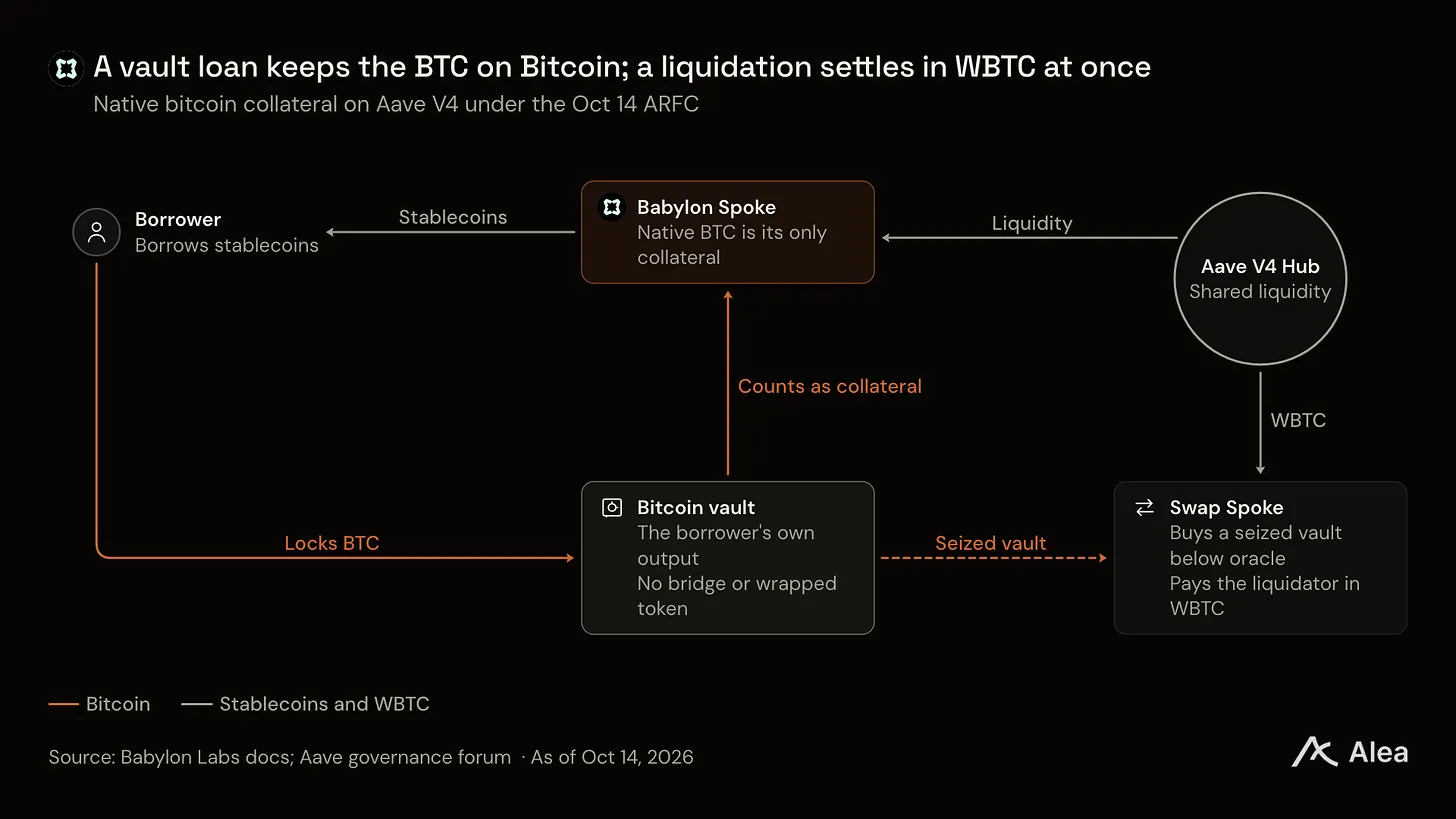
Under the proposal as published on the Aave governance forum, a borrower would lock BTC in a Taproot vault on the Bitcoin chain. The coins would remain at an address in the borrower’s own name, with the holder keeping control of the private keys. Ethereum would generate a non-transferable accounting token in the same amount as the locked bitcoin, and that token would be the collateral receipt inside Aave V4.
TechFlow described this as bitcoin entering Ethereum’s largest lending market in native form, and as the first Aave proposal for unwrapped native bitcoin. The outlet noted that Aave had already deployed a dedicated market for LBTC. Citing Cointelegraph, it said Aave’s existing bitcoin collateral was mainly wrapped assets such as WBTC and cbBTC, with the underlying bitcoin held by a custodian and the user bearing counterparty risk.
Collateral terms and the cost comparison
Parameters from the risk-control firm LlamaRisk set a 78% collateral ratio for native BTC and a maximum liquidation bonus of 5.55%. PANews reported that this collateral ratio and the borrow rate were comparable to wrapped assets such as WBTC and cbBTC on Aave V4’s core market.
On cost, Alea Research relayed Babylon’s expectation that the annualized cost of borrowing through the vault would be 3% to 5%, set against a 9% to 16% range described as common on centralized lending platforms. That is Babylon’s estimate as carried by Alea Research, not a rate the November 10 report treated as already in force on Aave. As of the end of the third quarter of 2026, about 40,481 bitcoin were staked on Babylon, all left on the Bitcoin chain in script form.
Which revenue is shared, and what is bought back
Only two streams count toward the split: the liquidity fee Aave charges on interest paid by borrowers on this Babylon line, and fees from liquidation. The first $500,000 each year would go entirely to the Aave DAO. In the tier from $500,000 to $2 million, the Aave DAO would take 78%, Babylon 18%, and 4% would fund buybacks. Further tiers step up. On the portion above $6 million, the Aave DAO would take 61.5%, Babylon 31.5%, and the buyback share would rise to 7%. The TechFlow report does not itemize every intermediate band.
Buyback funds would buy tokens in the open market, 85% AAVE and 15% BABY. Tokens bought would be split equally between the Aave DAO and the Babylon Foundation.
Alea Research calculated a scenario, not a claim that revenue would reach this level: if annual revenue on the line were $10 million, the Aave DAO would receive about $6.92 million, Babylon about $2.52 million, and buybacks about $560,000, of which about $84,000 would buy BABY. Alea Research said this would be the first channel through which BABY received value from borrower interest.
TechFlow judged the buyback small beside the tokens’ existing scale. A proposal passed on the Aave governance forum in March 2026 cut AAVE’s own annual buyback budget from $50 million to $30 million. For BABY, Alea Research counted about 1.58 million newly issued tokens a day; at third-quarter prices, a year of new tokens was worth about $7 million.
Starting limits, and a liquidation path that still uses WBTC
The proposal text sets an initial credit line from Aave’s core pools: $8 million each of USDT and USDC, $2 million each of USDG and RLUSD, and $1 million of GHO, about $21 million in total. The cap on native BTC collateral is 300 BTC. Later increases would follow demand, but each one would need Aave DAO approval. Alea Research put effective loans across Aave V4 in September 2026 at about $310 million. TechFlow treated the starting line, and whether it can be scaled, as a hurdle still ahead of the proposal.
Liquidation is the other constraint. Because the bitcoin stays on the Bitcoin chain, the proposal adds a settlement module: a liquidator buys the seized vault with WBTC, and an arbitrageur then redeems BTC on the Bitcoin chain. Posting collateral would no longer depend on a custodian. Liquidation still would depend on WBTC, a custodial wrapped asset. The November 10 report leaves open whether that market can support the line.
Emergency pause would be held by a 3-of-5 multisig that includes Aave Labs, LlamaRisk, and Babylon, among others. Pause and resume would have no time lock. During a pause, repayment and liquidation would also be blocked. The multisig would not be able to transfer users’ bitcoin.
What the November 10 report left dated and unresolved
Two dates were still ahead when TechFlow published. Alea Research said Babylon planned to submit a BABY token-economics adjustment to governance before the end of November 2026, with the direction that more new issuance flow to the vault business. Separately, about 2,999 BTC staked through Gate custody was due to expire around November 30, 2026. TechFlow reported that if it were not renewed, the size of bitcoin staked with Babylon would change. This rewrite does not add whether either item later happened.
The revenue percentages above are terms written into the proposal. Dollar outcomes depend on the AIP, on fees actually earned from this line’s interest and liquidations, and on usage inside the caps. TechFlow’s own closing judgment was that how much real buyback this native-bitcoin lending business could create for AAVE and BABY would also depend on whether the BABY token-economics change was in place before mainnet. That condition belongs to the November 10 report. It is not a result already observed there.
Original report: Babylon 敲开 Aave 大门,比特币直接抵押就能借稳定币? — 库里, TechFlow (深潮 TechFlow), published November 10, 2026, 20:53 UTC+8. This is an English restatement of that report and adds no developments after its publication time.