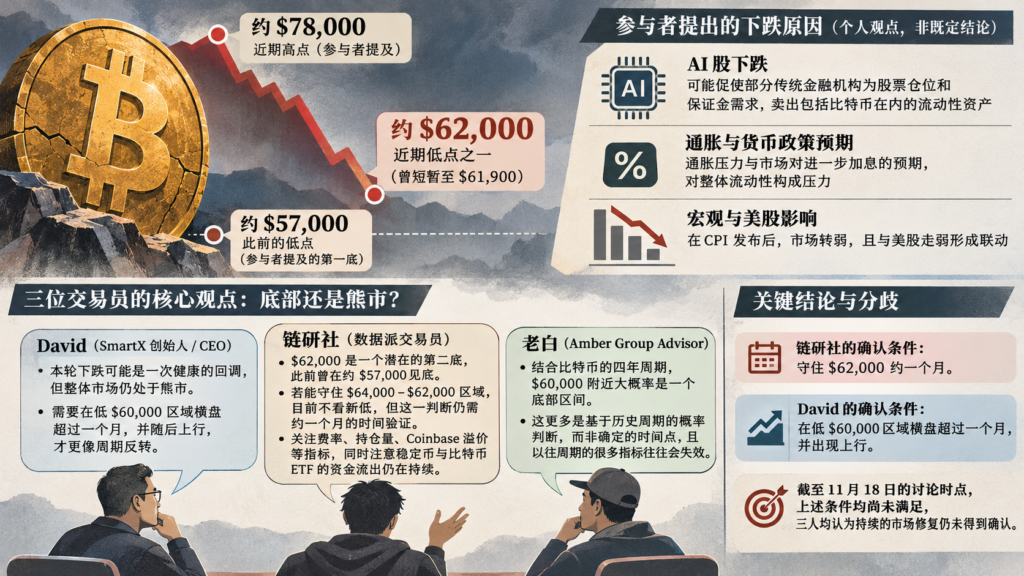
As reported on November 18, 2026, three traders discussing Bitcoin’s recent decline disagreed on whether the market was forming a bottom or remained in a bear-market phase. All treated a sustained recovery as unconfirmed.

What they think drove the sell-off
David, SmartX’s founder and CEO, said Bitcoin fell from roughly $78,000 to about $62,000—briefly reaching $61,900—in less than a week. In his view, long-position liquidations alone did not explain the move. He argued that falling AI shares may have forced traditional financial institutions to sell liquid assets, including Bitcoin, to meet stock-position and margin needs. He also pointed to inflation and expectations of tighter monetary policy as pressures on liquidity. These were his explanations, not established causes of the decline.
The trader known as 链研社 also linked Bitcoin’s weakness to macroeconomic conditions and equities. He said the decline intensified after a CPI release and exceeded the pullback he had expected near the 120-day moving average, which he placed around $75,000.
The levels under discussion
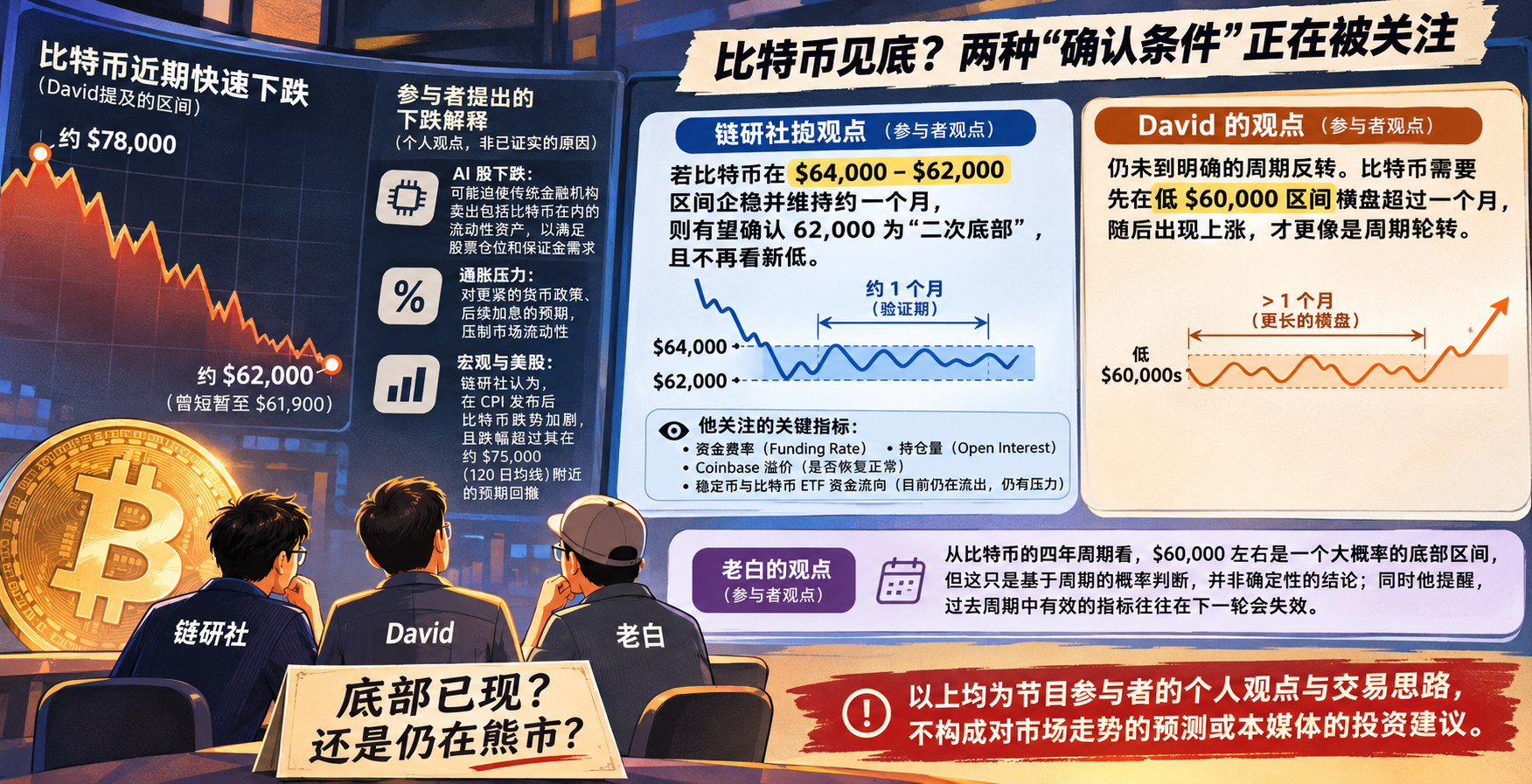
链研社 called $62,000 a potential second bottom, following an earlier low near $57,000. As of the discussion, he did not expect a new low if Bitcoin held the $64,000–$62,000 area, but said that view still needed testing over roughly the following month. He cited funding rates, declining open interest and a normalizing Coinbase premium as indicators to watch. He also said stablecoin and Bitcoin ETF outflows were continuing, leaving pressure on the market.
David was less ready to call a cycle turn. Although he described the latest drop as potentially a healthy pullback, he said the broader market was still bearish. For him, Bitcoin would need to trade sideways in the low $60,000s for more than a month and then rise before the move looked more like a cycle reversal.
老白 viewed the area around $60,000 as a probable bottom zone, using Bitcoin’s four-year cycle as a rough guide rather than a precise timing tool. He cautioned that indicators carried over from earlier cycles often fail and framed his bottom assessment as a probability, not a certainty.
The distinction is consequential: holding $62,000 for the next month was 链研社’s proposed confirmation test, while David required both a longer consolidation and an upward move. Neither condition had been met at the time of the November 18 report.