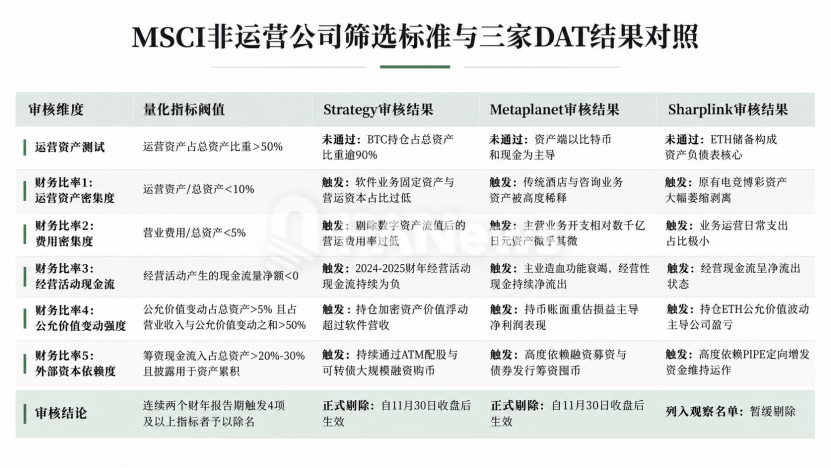
MSCI will remove Bitcoin treasury companies Strategy and Metaplanet from its indexes after the close on November 30, 2026, according to a November 12 report by PANews. The decision directly affects demand for their shares, not their Bitcoin holdings. Its longer-term significance depends on whether reduced index ownership makes it harder for the companies to raise money to buy more Bitcoin.
Why the companies were removed
MSCI finalized broader rules for identifying non-operating companies on October 15, after a market consultation that began in August. The framework examines operating assets and five financial ratios. PANews reported that Strategy and Metaplanet failed the relevant tests. UK uranium investment company Yellow Cake was also removed, indicating that the decision was not limited to digital-asset treasuries. An earlier proposal to exclude companies whose digital assets exceeded 50% of total assets had been withdrawn.
As of November 8, Strategy held 850,364 BTC, acquired for about $64.16 billion in total; its software business reported $125.4 million in third-quarter 2026 revenue. Metaplanet held 44,000 BTC, according to PANews. Strategy chairman Michael Saylor criticized MSCI’s treatment of Bitcoin relative to other assets. Metaplanet CEO Simon Gerovich said the index change would not disrupt the company’s operations or Bitcoin strategy.
Ethereum treasury company SharpLink Gaming was placed on a watchlist rather than removed. PANews said existing constituents receive more time under MSCI’s rules than applicants for inclusion; SharpLink’s eventual status remains unresolved.
The share-demand and financing questions
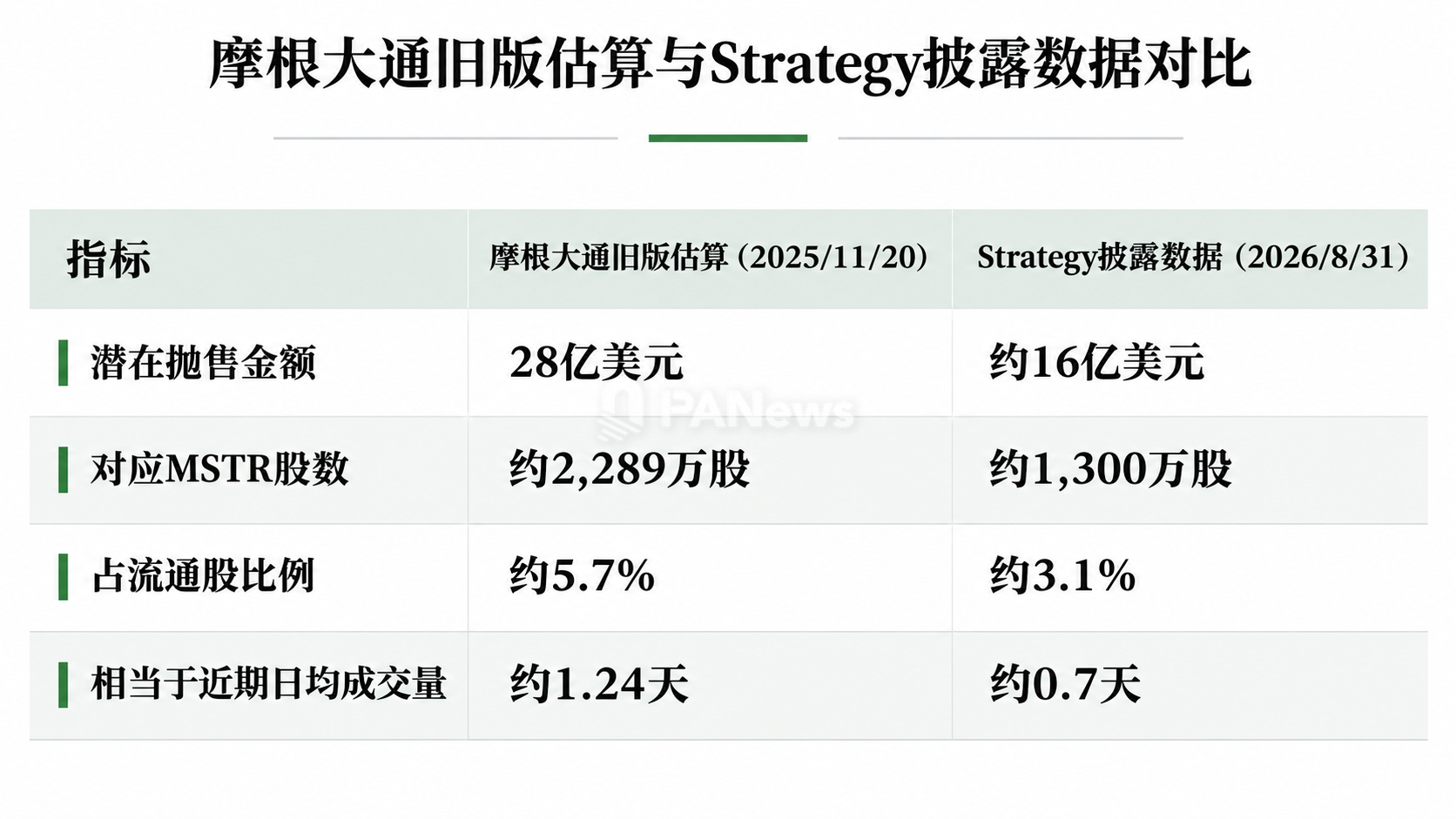
PANews cautioned against treating older estimates of $2.8 billion in potential passive selling, or $8.8 billion if other index providers followed MSCI, as current forecasts. Those figures came from a JPMorgan report issued a year earlier.
Using Strategy’s disclosed passive-fund ownership of 13 million shares and its November 11 closing price of $122.35, PANews estimated roughly $1.59 billion in potential selling—about 3.2% of shares outstanding and 0.7 days of its recent average trading volume. That comparison describes the scale of possible turnover; it does not establish how much will be sold at once or at what price.
The more persistent risk is to Strategy’s financing model. PANews put its market-value-to-Bitcoin-holdings ratio, or mNAV, at 1.08. If weaker index demand narrows or eliminates the share premium, issuing stock to fund further Bitcoin purchases could become less attractive. Strategy has itself acknowledged that index removal could hurt its share price, liquidity and future financing ability.
In a November 9 filing cited by PANews, Strategy reported net proceeds of about $283.8 million from selling approximately 2.05 million common shares during November 2–8. It allocated $188.3 million to repurchasing STRC preferred shares, $81.9 million to buying 1,036 BTC, and $13.6 million to cash reserves. The allocation illustrates competing uses for newly raised capital, but one week does not establish a lasting change in its Bitcoin-buying capacity.
What this does—and does not—imply for BTC
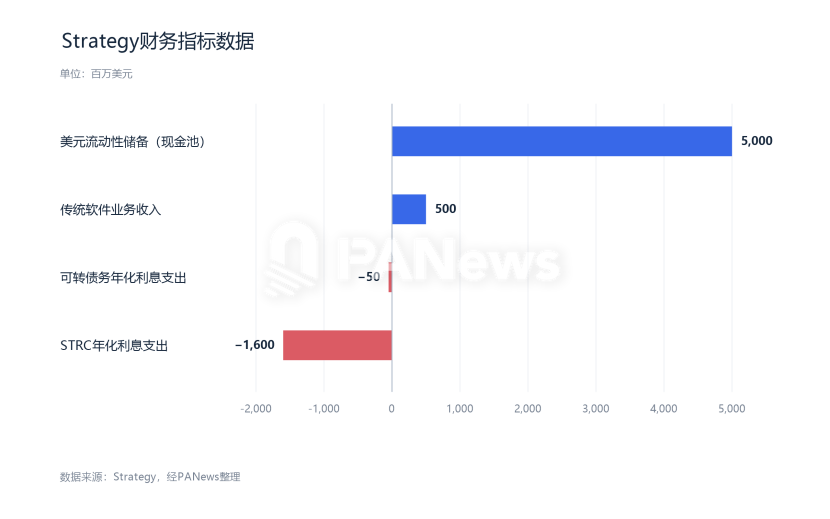
PANews argued that an immediate forced sale of Strategy’s Bitcoin was not indicated by the financial position it described. It cited nearly $5 billion in cash reserves and attributed to Bitwise CIO Matt Hougan the view that the larger debt-repayment pressures fall in 2028–2030, rather than the near term. Those assessments do not remove financing or market risk.
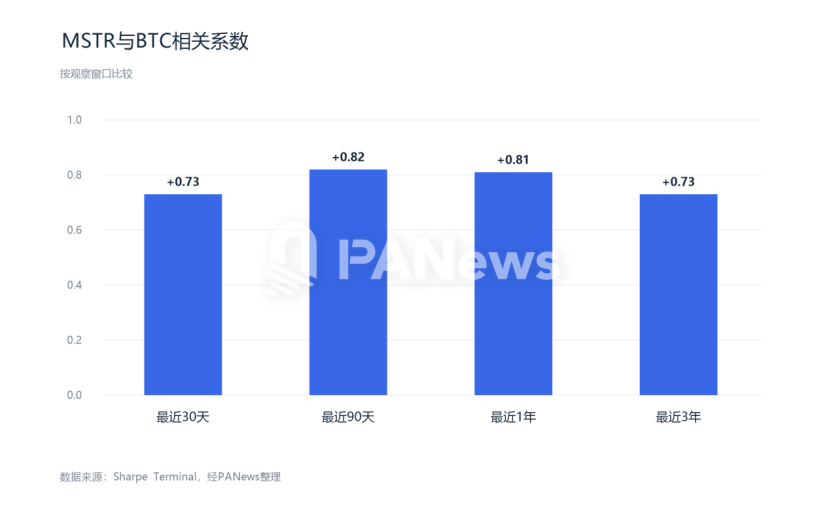
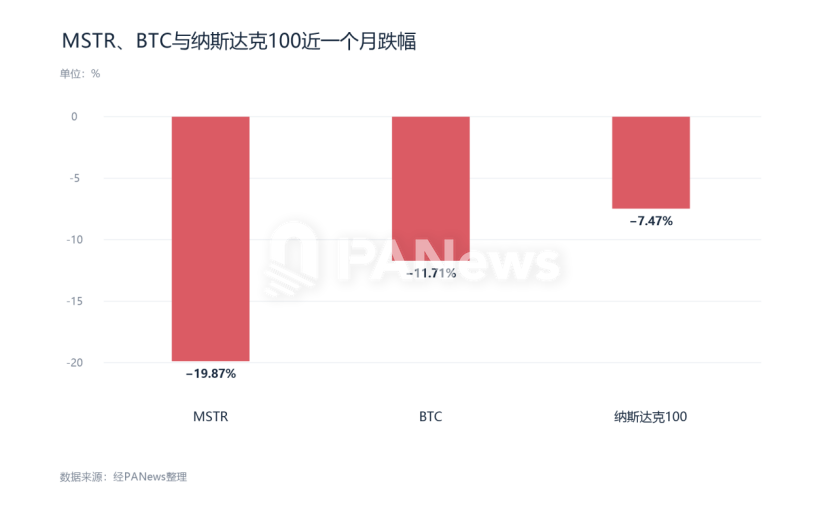
Strategy shares and Bitcoin have moved in the same direction over the periods PANews examined, but not by the same amount. From October 15 to the November 11 close, it reported a nearly 20% decline in Strategy shares, versus a Bitcoin decline of less than 10%. Index eligibility, dilution and the share premium can affect Strategy independently of BTC. The MSCI decision therefore presents a clearer direct risk to the companies’ equity financing than to Bitcoin’s price; any effect on future BTC purchases remains conditional on their ability to raise capital.