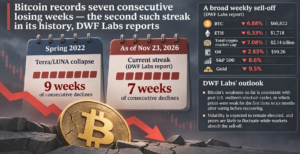
In a report published on November 24, 2026, Glassnode Insights described a Bitcoin market still under pressure after a sharp sell-off. As of Monday, BTC was trading near $63,000, slightly above a weekly close that followed a roughly 6% decline. The sell-off intensified on Friday and Saturday, when the price briefly reached the mid-$50,000s.
Selling eased, but buyers had not taken control
Glassnode’s spot price-momentum reading fell 28.3% over seven days, from 24.1 to 17.2, and remained below its lower range. Selling pressure moderated by Sunday: spot cumulative volume delta (CVD) improved from negative $170.8 million to negative $120.9 million, while perpetual-futures CVD improved from negative $1.5 billion to negative $486.5 million. Both readings remained negative, so the change indicated less aggressive selling—not a confirmed shift to net buying.
Spot trading volume rose 6.9% to $8.8 billion from $8.2 billion and peaked as the price fell on Saturday. Glassnode interpreted the elevated turnover as evidence of substantial position changes during the decline.
Futures leverage declined; options traders sought protection
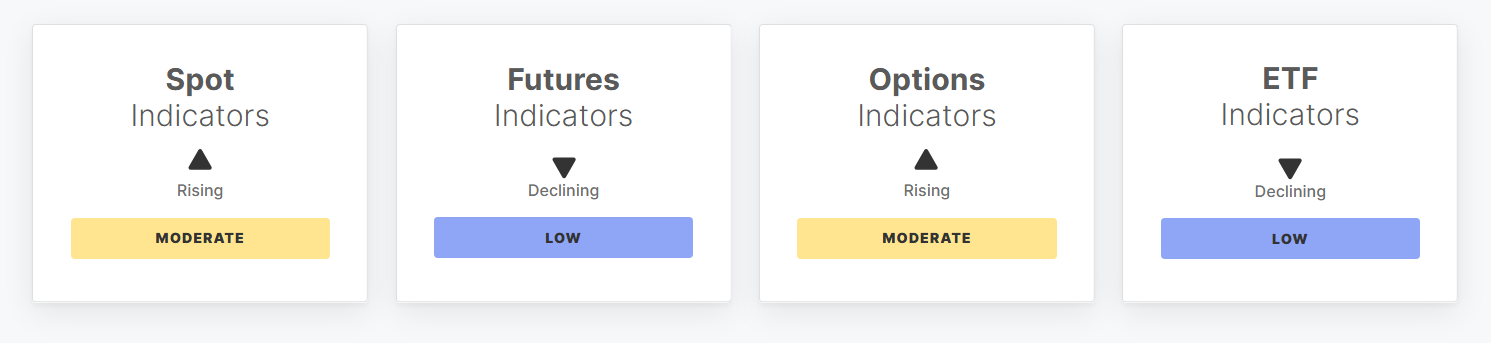
Futures open interest fell 12.0% over seven days, from $33.3 billion to $29.3 billion, its lowest level since early March. Long-side funding payments dropped 53.6%, from $1.7 million to $803,900. Glassnode viewed the two declines as signs that leveraged long exposure had been reduced.
Options data pointed to continuing caution. Options open interest edged up 2.6%, from $31.9 billion to $32.7 billion. The volatility spread rose from 4.9% to 10.2%, while 25-delta skew increased from 14.4% to 17.4%, its highest reading since mid-July. In Glassnode’s interpretation, the skew reflected stronger demand for downside protection.
ETF flows and holder losses remained a constraint
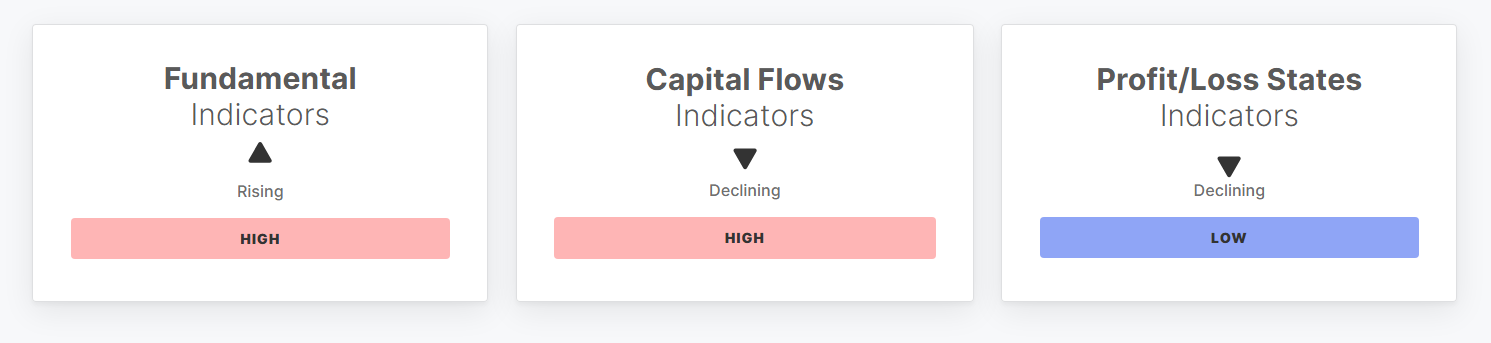
U.S. spot Bitcoin ETFs recorded $1.7 billion in weekly net outflows, compared with $801.4 million the previous week—the largest weekly outflow since early July. Weekly ETF trading volume rose 22.0%, from $12.6 billion to $15.4 billion. ETF MVRV fell from 1.05 to 0.97, below the 1.0 level Glassnode uses as an average cost-basis benchmark. On that measure, ETF holdings were at an average unrealized loss.
On-chain measures also showed strain. The share of Bitcoin supply in profit fell from 54.2% to 47.3%, its lowest reading since early July. Glassnode’s short-term-holder net unrealized profit-and-loss reading worsened from negative 9.4% to negative 18.3%, its lowest since mid-June. Its reported realized profit-to-loss reading declined from negative 1.43 to negative 1.88, alongside substantial loss-taking.
Activity increased during the decline: daily active addresses rose 3.1% to 676,600, and entity-adjusted transfer volume increased 1.5% to $5.6 billion. At the same time, total fees slipped 1.8% to $187,500, their lowest reading since late October. Monthly realized-cap change weakened from negative 0.06% to negative 0.93%; the short-term- to long-term-holder supply ratio rose from 15.0% to 15.5%; and the hot-capital share edged down from 22.0% to 21.9%.
Glassnode’s evidence supports a narrower conclusion than a confirmed market bottom: leverage and aggressive selling had eased, but ETF outflows, demand for downside hedges and losses among recent buyers remained. Its oversold reading, the report cautioned, did not by itself establish that the decline was over.