Cointelegraph reported on Nov. 10, 2026, that Binance Research, in a Tuesday note shared with the outlet, said Bitcoin could find support before major central banks start cutting rates if the spread of rate hikes continues to slow. The points below restate that report. They are not a later market update, and any outlook in the source is attributed to its author.
What Binance counted
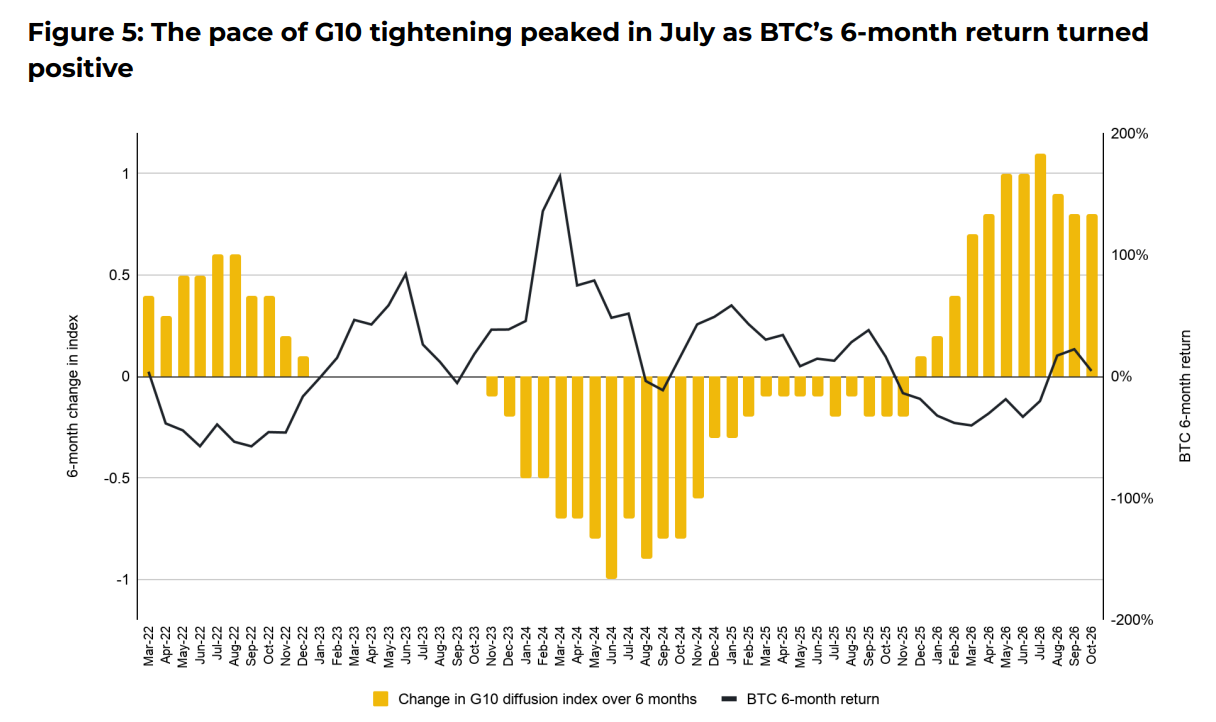
Binance Research said eight of the 10 central banks it tracks had raised rates over the prior six months, including Sweden’s increase announced on Nov. 4. It said the momentum of tightening had started to ease since a July peak. The report said: “Whether this easing continues into early 2027 will be key to judging whether the macro backdrop is turning less hostile for crypto.”
The support claim is conditional on that slowing continuing. Binance did not describe policy as already easy, and it did not say cuts had begun.
The earlier cycles Binance cited
Binance pointed to the previous cycle. It said Bitcoin bottomed in November 2022 and that its six-month return turned positive in February 2023, before any central bank in the index began cutting rates.
It also said that in 2024, monetary tightening measures led to Bitcoin delivering its “strongest” six-month return of the cycle, exceeding 160% in March. The report added: “In each case, BTC moved with the direction of global policy, not its level.”
That comparison is Binance’s. The mechanism it names is the direction of global policy—whether tightening is still spreading or starting to slow—rather than the level rates have already reached. The source does not treat the March 2024 return as a figure that must recur.
A December U.S. hike was still in play
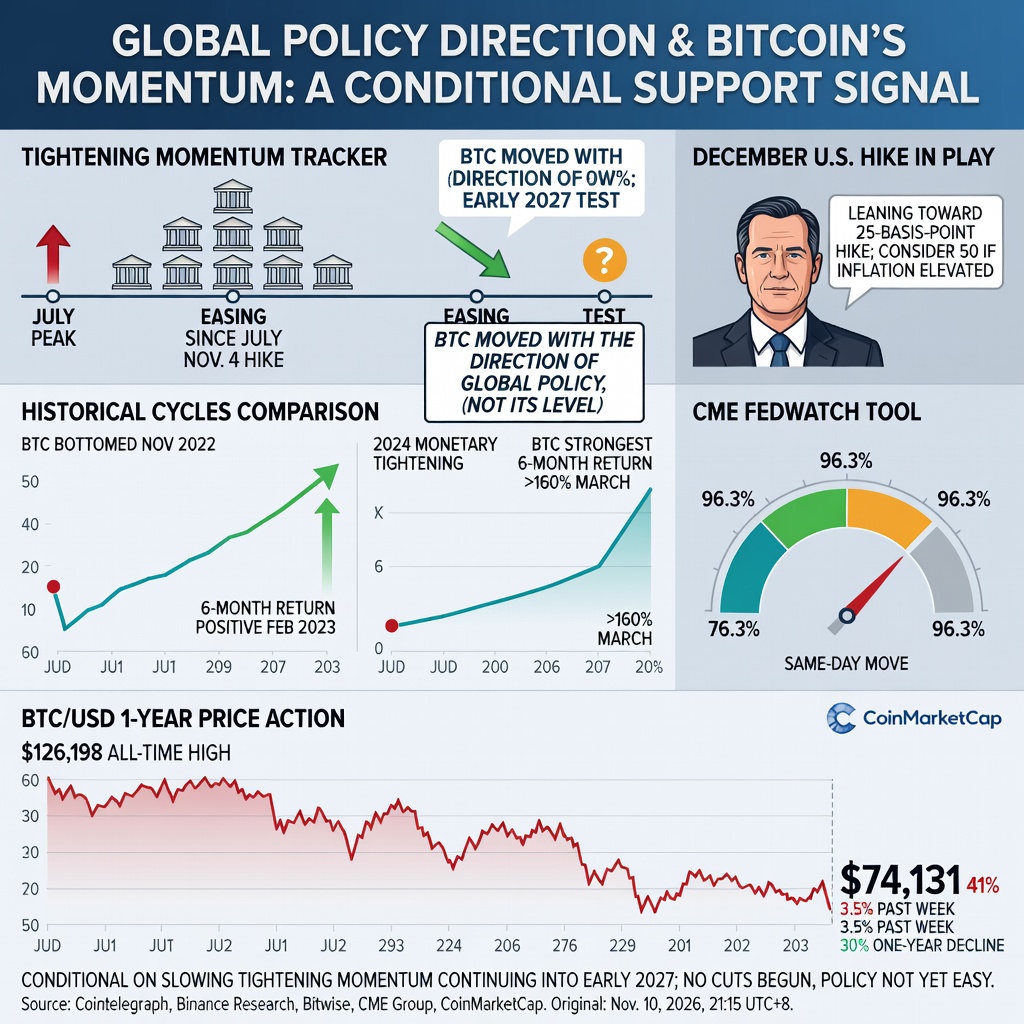
Cointelegraph reported that a U.S. rate increase remained in play. Federal Reserve Governor Christopher Waller said Tuesday he was leaning toward a quarter-point hike in December and would consider a half-point move if core inflation remained elevated. Odds of a 25-basis-point December hike rose from 76.3% to 96.3% on Tuesday, according to CME Group’s FedWatch Tool.
In a separate Nov. 2 report, Bitwise argued that a slowdown in economic-growth expectations could eventually prompt central banks to pivot toward easier policy, potentially creating a more favourable environment for Bitcoin. That is Bitwise’s argument, not a conclusion of this article.
The price levels in the report
Citing CoinMarketCap, Cointelegraph said Bitcoin’s price had fallen 3.5% during the past week, extending its one-year decline to 30%. It was trading at $74,131, or 41% below its $126,198 all-time high.
Conditions that would weaken the reading
Binance’s stated test runs into early 2027: whether the easing in tightening momentum continues. The “less hostile” case it describes would be weaker if the share of hiking central banks stopped shrinking, or if policy tightened further rather than merely staying restrictive. Waller’s remarks and the same-day FedWatch move kept a December hike—and a possible half-point move if core inflation stayed elevated—on the table. Under the report’s own distinction, a high rate level is not the signal; a renewed turn in the direction of tightening would work against it. The source sets no price target and no date for cuts.
Original article: Cointelegraph, published Nov. 10, 2026, 21:15 UTC+8.
Timing in that article: Bitwise’s report is dated Nov. 2; Sweden’s increase is dated Nov. 4; Binance Research and Waller’s comments are described as Tuesday in a story published Nov. 10, 2026. The historical markers Binance cites are November 2022, February 2023, and March 2024.