A Decrypt report published at 2026-11-11 00:27:57 UTC+8 said Bitcoin fell below $74,000 on Tuesday after U.S. inflation for October came in hotter than expected for a third consecutive month, adding pressure to a crypto market already dealing with lower prices and investor withdrawals.
October inflation versus forecasts
The Bureau of Labor Statistics reported that the Consumer Price Index rose 0.4% in October, above economists’ 0.3% forecast. Core CPI, which strips out food and energy, rose 0.3% against a 0.2% forecast and matched September’s reading for a third consecutive month. Headline inflation slowed from September’s 0.6% increase, but Decrypt said that slowdown offered little relief because traders had expected a larger one. Both the headline and core monthly figures exceeded forecasts by 0.1 percentage point, which the report described as another reason for the Federal Reserve to keep interest rates elevated.
Within the monthly mix, food prices rose 0.5%, energy rose 0.7%, and shelter rose 0.3%. Shelter accounted for more than 30% of the monthly headline increase. Energy inflation slowed considerably from September’s 5.2% surge, while Decrypt said price increases remained widespread across services: recreation costs rose 0.8%, motor vehicle insurance rose 0.7%, and medical care rose 0.3%.
The government did not publish its standard annual inflation rate. Decrypt attributed that gap to the 2025 federal shutdown, which prevented collection of October data that year. September’s last available annual headline reading was 3.7%, well above the Fed’s 2% inflation target. That target is formally measured with the Personal Consumption Expenditures index, not CPI.
How Bitcoin and the wider crypto market moved
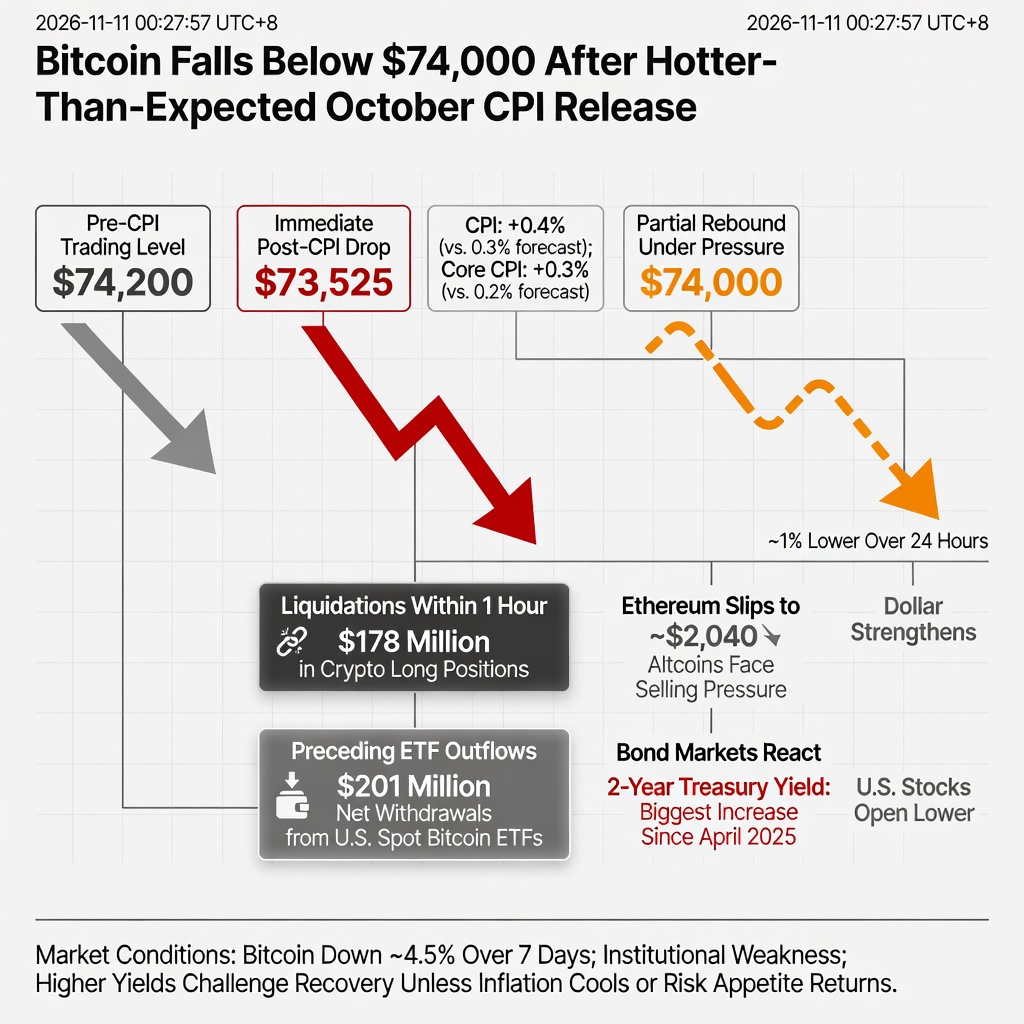
Decrypt reported that Bitcoin was trading near $74,200 before the announcement and briefly dropped to approximately $73,525 immediately afterward. It recovered some ground toward $74,000 but remained under pressure, trading roughly 1% lower over 24 hours. Ethereum also weakened, slipping toward $2,040 during the initial selloff, while other major altcoins faced selling pressure.
Approximately $178 million in crypto long positions were liquidated within an hour of the announcement. Decrypt defined those liquidations as exchanges automatically closing trades made with borrowed money when owners no longer have enough collateral to cover potential losses, and noted that those forced sales can push prices lower and trigger further liquidations.
The inflation release came during an already difficult week for Bitcoin. Decrypt said the asset had lost roughly 4.5% over seven days, while U.S. spot Bitcoin ETFs recorded another $201 million in net withdrawals on Monday, extending selling that preceded the report.
The rate link, as Decrypt and cited officials framed it
Decrypt’s mechanism was conditional rather than a price forecast: higher inflation usually means higher interest rates, and higher rates tend to be unfavorable for crypto because bonds and cash can offer returns while Bitcoin generates no interest simply by being held. Higher borrowing costs can also reduce cheap funding for speculative investments. The outlet said that is why Bitcoin, despite its reputation as an inflation hedge, has frequently fallen when inflation data suggests the Fed will tighten policy. That is Decrypt’s reading of a repeated pattern, not a determination of what Bitcoin must do next.
The CPI report landed hours after Fed Governor Christopher Waller, speaking in London, made unusually aggressive comments about the next move. Waller said he would support a quarter-percentage-point increase in December even if inflation improved, but warned that another core CPI reading of 0.3% could justify a larger move. He said: “I believe a 50 basis point hike in the policy rate should be considered at the December meeting.” October’s core reading hit that 0.3% threshold.
According to Reuters, as cited by Decrypt, financial analysts increased their estimated probability of a 50-basis-point hike to nearly 15% by midmorning, although a smaller quarter-point increase remained the overwhelming favorite. Decrypt stated that the Fed’s benchmark rate was then between 3.75% and 4%. A 50-basis-point increase would lift that range to 4.25%–4.50%, making borrowing more expensive across the economy.
Bond markets reacted with those expectations. The two-year Treasury yield, which Decrypt said closely tracks expectations for Fed policy, posted its biggest increase since April 2025. The dollar strengthened, and U.S. stocks opened lower.
What the report left unresolved before December
Decrypt said crypto investors had seen a similar sequence before: in October, Bitcoin fell after September’s hotter-than-expected inflation report, and the selloff continued as rate-hike expectations strengthened. This time, the market was described as entering the next Fed meeting with Bitcoin substantially below its October levels and with institutional demand showing signs of weakness. Decrypt said higher Treasury yields could make a sustained recovery more difficult unless inflation cools or investors regain their appetite for risk. Those are conditions in the original report, not a conclusion that either outcome will occur.
The Fed’s final policy meeting of 2026 was scheduled for December 8–9. The next CPI report was due on December 10, so policymakers would make the December rate decision without seeing November’s consumer inflation figures. At the time of the Decrypt report, the quarter-point move was still the overwhelming favorite; the nearly 15% figure was an analyst probability estimate, and Waller’s 50-basis-point remark was his stated case for what should be considered.
Bitcoin Falls as Hot US Inflation Fuels Fears of Bigger Fed Rate Hike — Decrypt, published 2026-11-11 00:27:57 UTC+8.