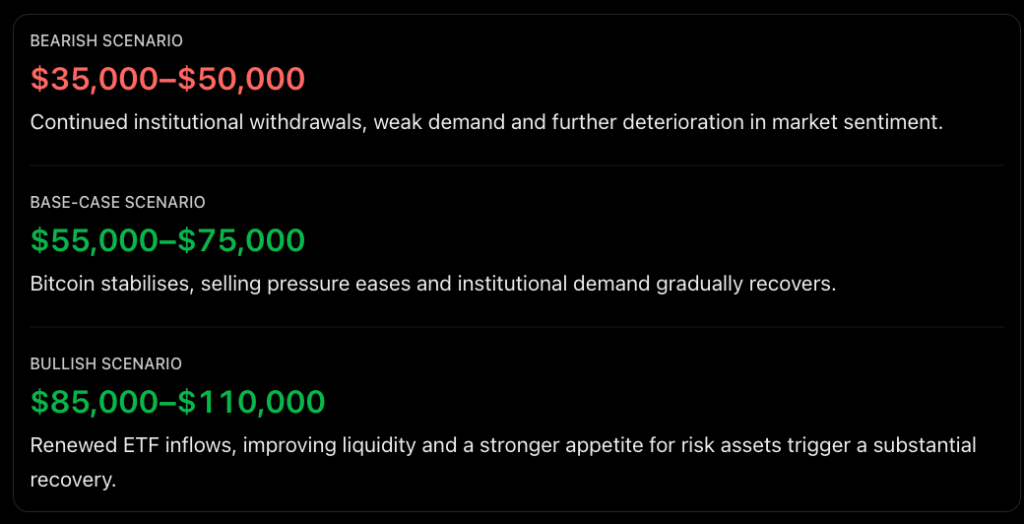
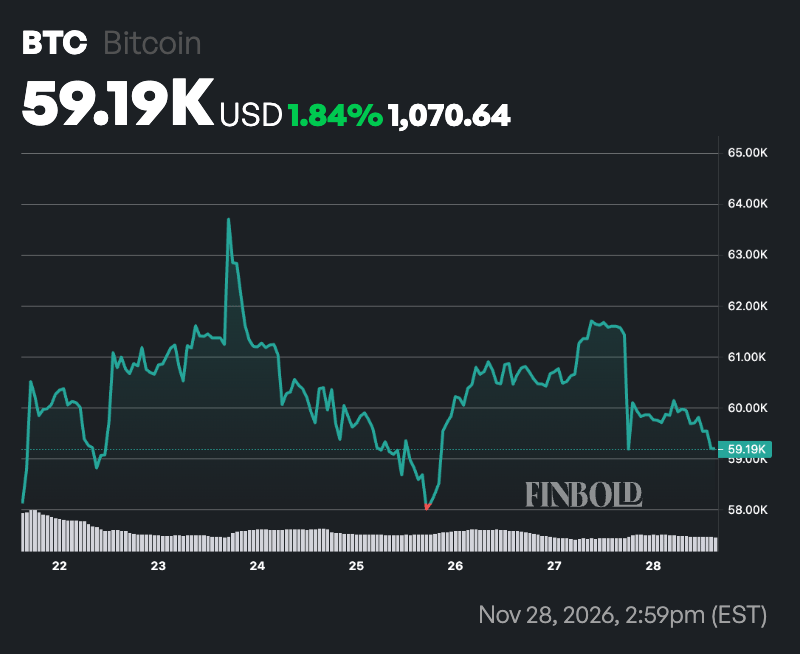
Bitcoin traded at $59,190 on November 28, 2026, after U.S. spot Bitcoin exchange-traded funds (ETFs) recorded their largest monthly withdrawals since launch. Against that backdrop, ChatGPT put its central estimate for Bitcoin at $65,000 by March 31, 2027. That estimate assumes selling pressure eases and institutional demand begins to recover. The model cautioned that reaching $65,000 would not, on its own, establish a new bull market.
What separates the three March scenarios
- Base case: $55,000–$75,000. ChatGPT expects Bitcoin to stabilize as selling slows and institutional buyers begin to return. Its projected path starts near $60,000 in November 2026, dips to about $57,000 in December, then rises to roughly $59,000 in January 2027 and $62,000 in February before approaching $65,000 at the end of March.
- Bearish case: $35,000–$50,000. If institutions continue to withdraw funds, demand weakens further and investor sentiment deteriorates, the model sees room for a deeper decline.
- Bullish case: $85,000–$110,000. ChatGPT said this range would likely require renewed inflows into spot Bitcoin ETFs, better market liquidity and a stronger appetite for risk assets.
U.S. spot Bitcoin ETFs had recorded approximately $5.39 billion in November outflows through November 25. ChatGPT identified a reversal of those flows as a potential source of support, while continued withdrawals could add to selling pressure. It also cited lower interest rates and improving sentiment as factors that could lift demand. In the model’s assessment, a convincing market reversal would require both sustained institutional demand and stronger price momentum.
Market conditions behind the forecast
At the November 28 reporting time, Bitcoin was down 4% over 24 hours but up almost 2% over seven days. It remained well below its October 2025 record of approximately $126,728. Its price was also below both the 50-day simple moving average of $74,343 and the 200-day average of $71,864, although the shorter average remained above the longer one. The 14-day relative strength index stood at 26.74, an oversold reading that can precede stabilization or a short rally even within a broader decline.
Citigroup’s base estimate was higher at $82,000, with a bearish estimate of $53,000. Bernstein projected $150,000 on a later horizon, by mid-2027, citing institutional adoption and growing demand.