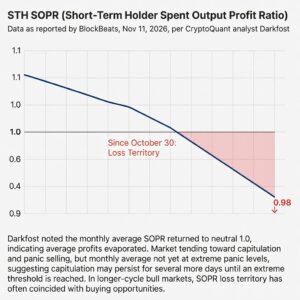
US spot Bitcoin exchange-traded funds recorded $95 million in net outflows on Tuesday, according to a Cointelegraph report published on November 11, 2026. Those withdrawals brought net outflows from US spot Bitcoin ETFs to roughly $1.6 billion since the start of November, based on SoSoValue data cited in the report. On the same session, investors were putting billions of dollars into stock funds during a market pullback.
This article restates that November 11, 2026 report. It is not a later market update, and it does not treat Tuesday’s session as current.
Equity funds took the week’s largest ETF inflows
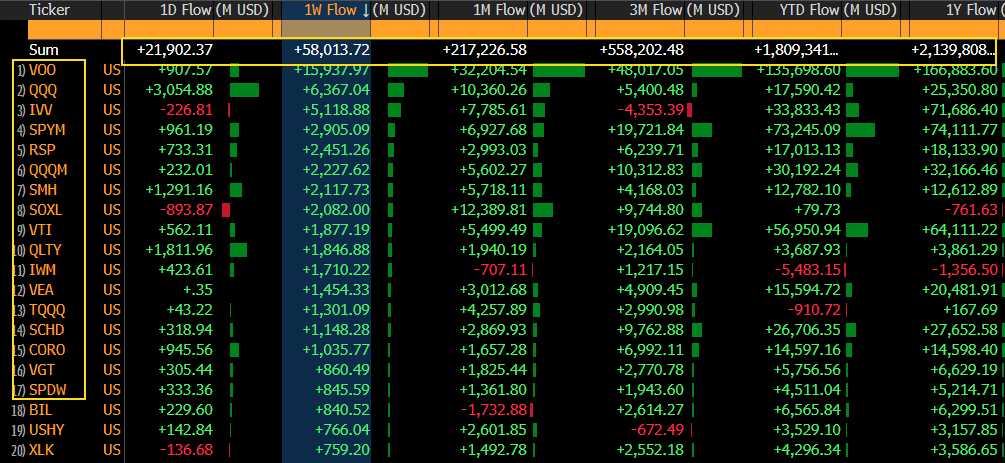
Bitcoin ETF outflows eased for a third straight session. Over five trading sessions, stock funds accounted for all 17 of the top US-listed ETFs by inflows, according to Bloomberg ETF analyst Eric Balchunas. Writing on X on Tuesday, Balchunas said US-listed ETFs attracted roughly $12 billion per day over those sessions and that equity ETF investors “devoured” the dip.
The biggest beneficiaries named in the report were Vanguard’s S&P 500 ETF (VOO), Invesco’s Nasdaq-100 ETF (QQQ), and BlackRock’s iShares Core S&P 500 ETF (IVV). A ranking of US-listed ETFs by one-week net inflows, led by equity funds, was attributed to Balchunas.
The documented split is between products, not a full map of Bitcoin demand. The report shows large inflows into equity ETFs alongside continued net withdrawals from spot Bitcoin ETFs. It does not provide separate figures for demand outside those US-listed funds.
IBIT’s streak accounted for most of the latest outflow
BlackRock’s iShares Bitcoin Trust (IBIT) recorded $78 million in net withdrawals on Tuesday, its eighth straight trading session of outflows. Over that streak, IBIT recorded about $1.73 billion in net outflows, according to Farside Investors.
Morgan Stanley’s Bitcoin Trust ETF (MSBT) attracted $20 million on Tuesday. Cointelegraph said those inflows were not enough to offset broader losses.
CryptoQuant called conditions extremely bearish, with a stated caveat
Daily net outflows from Bitcoin ETFs slowed from $430 million on Thursday and $412 million on Friday to $201 million on Monday and $95 million on Tuesday, but broader market indicators remained weak, according to CryptoQuant.
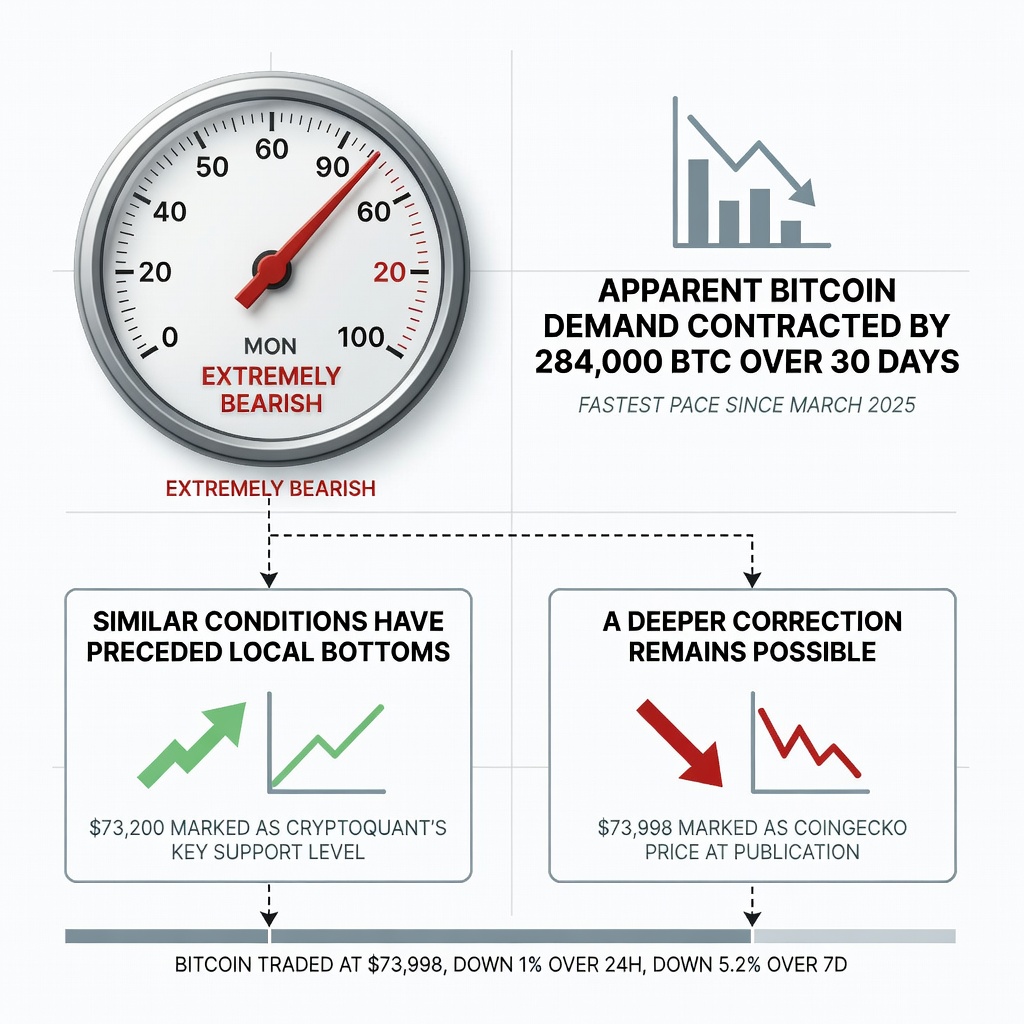
CryptoQuant’s Bitcoin Bull Score Index dropped to 20 on Monday from 90 on October 13. A Tuesday report seen by Cointelegraph described that reading as “extremely bearish.” The analysts reported that apparent Bitcoin demand contracted by 284,000 BTC over 30 days, the fastest pace since March 2025.
CryptoQuant said similar conditions have preceded local market bottoms, but it warned that a deeper correction remains possible and identified $73,200 as a key Bitcoin support level. That support level, the bottom analogue, and the warning of a deeper correction are CryptoQuant’s statements as relayed by Cointelegraph. They are not a conclusion of this desk, and the report attaches no probability or date to either outcome.
At the time Cointelegraph published, Bitcoin traded at $73,998, down 1% over the prior 24 hours and down 5.2% over the prior seven days, according to CoinGecko. The published spot price was near the support level CryptoQuant named. The report did not say that level had been reached or that it would hold.
What would change the reading
The mechanism in the source is a divergence in reported flows: spot Bitcoin ETF redemptions were still negative but smaller than earlier in the sequence, while equity ETFs absorbed very large daily inflows and filled all 17 of the top inflow slots. November’s cumulative Bitcoin ETF outflow, roughly $1.6 billion, is much larger than Tuesday’s $95 million print. Easing daily redemptions is not the same thing as a reversal.
The bearish interpretation depends on CryptoQuant’s indicators remaining in the zone it labeled extremely bearish, including the Bull Score drop from 90 to 20 and the 30-day apparent-demand contraction of 284,000 BTC. CryptoQuant itself limited that reading: similar conditions have preceded local bottoms, and a deeper correction was still described as possible. Evidence that would weaken the bearish side of that statement would be a confirmed local bottom of the kind CryptoQuant said had followed similar conditions before, or a further shift from the already slowing outflow path into sustained net inflows. Neither result is reported in the article. ETF flows, the Bull Score, and apparent demand are presented as separate measures; the source does not show that a change in one automatically confirms a change in the others.
Original report: Cointelegraph, November 11, 2026, 16:55 UTC+8