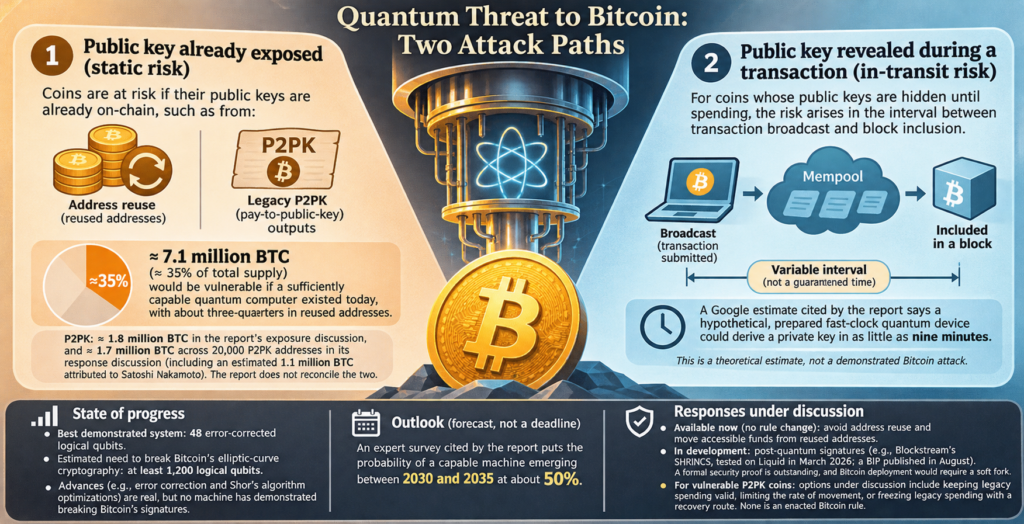
A report by the Bitcoin Security Consortium, prepared with Presidio Bitcoin, says quantum-computing advances warrant preparation but have not demonstrated a machine capable of breaking Bitcoin’s signatures. The report identifies two distinct risks: attacks on coins whose public keys are already exposed, and attacks during the interval between a transaction’s broadcast and its inclusion in a block.
What is exposed today?
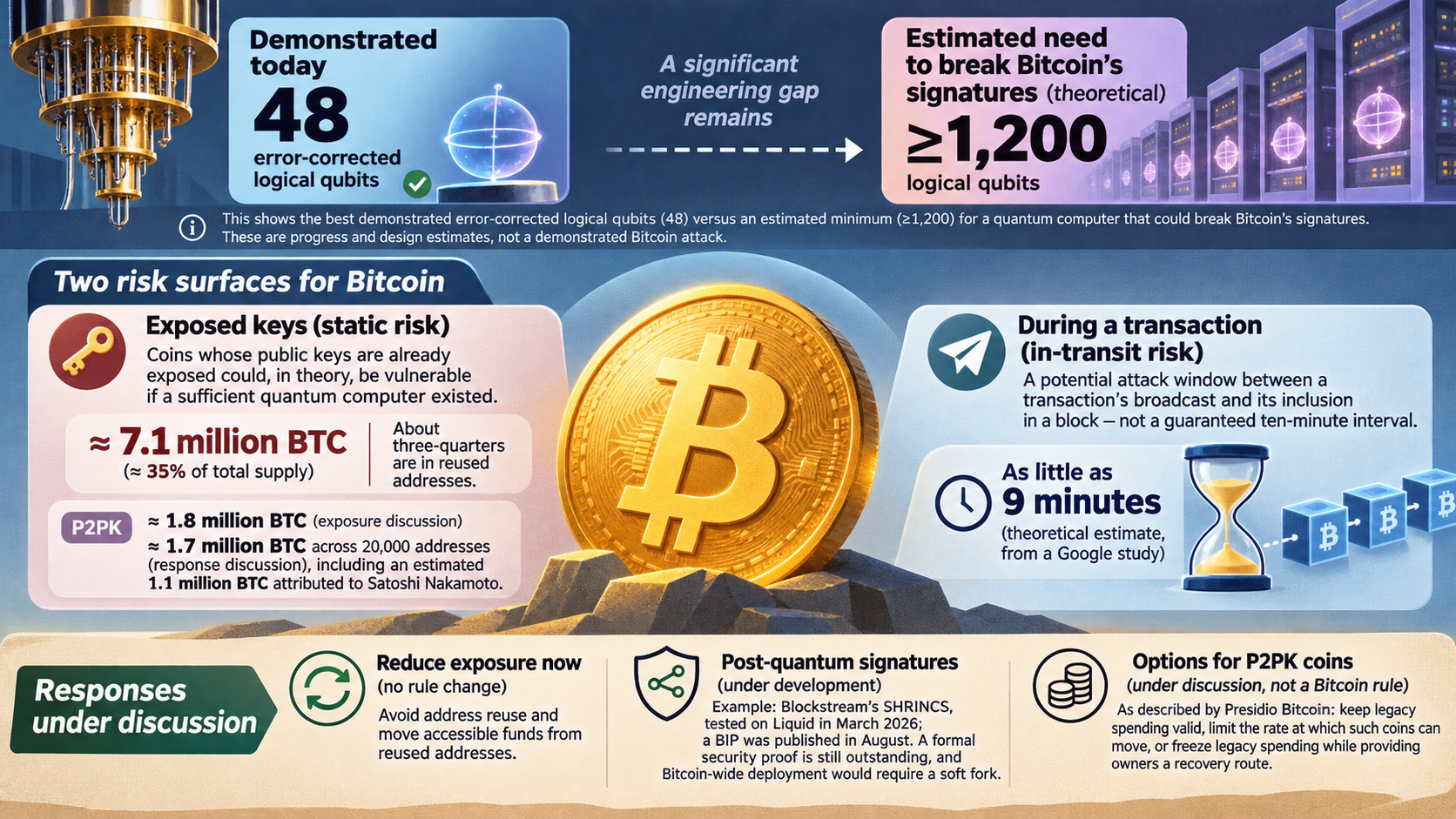
A sufficiently capable quantum computer running Shor’s algorithm could, in theory, derive a private key from an exposed public key. Citing Project Eleven, the report estimates that about 7.1 million BTC, or roughly 35% of the total, would be vulnerable if such a computer existed today. It says about three-quarters of that amount is in reused addresses, where moving funds to addresses that have not previously been spent from could reduce exposure.
Older pay-to-public-key (P2PK) outputs pose a harder problem because many are presumed lost. The report gives two figures in different contexts: approximately 1.8 million BTC in P2PK addresses in its exposure discussion, and approximately 1.7 million BTC across 20,000 P2PK addresses in its discussion of possible responses. It does not reconcile them. The latter figure includes an estimated 1.1 million BTC attributed to Satoshi Nakamoto.
For coins whose public keys remain hidden until spending, the concern is different. The report describes a potential attack window between transaction submission and block inclusion—not a guaranteed ten-minute interval. It cites a Google estimate that a hypothetical, prepared fast-clock quantum device could derive a private key in as little as nine minutes. That is a theoretical estimate, not a demonstrated Bitcoin attack.
Progress is not a working attack
The report points to advances in error correction and proposed optimizations of Shor’s algorithm, while stressing the remaining engineering gap. It says the best demonstrated system has produced 48 error-corrected logical qubits, versus an estimated at least 1,200 needed to break Bitcoin’s elliptic-curve cryptography. Its cited 2026 attack calculations are designs or estimates, not results from a cryptographically relevant quantum computer.
The consortium also cites an expert survey placing the probability of a capable machine emerging between 2030 and 2035 at about 50%. That is an attributed forecast, not a deadline or evidence that an attack is imminent.
Responses under discussion
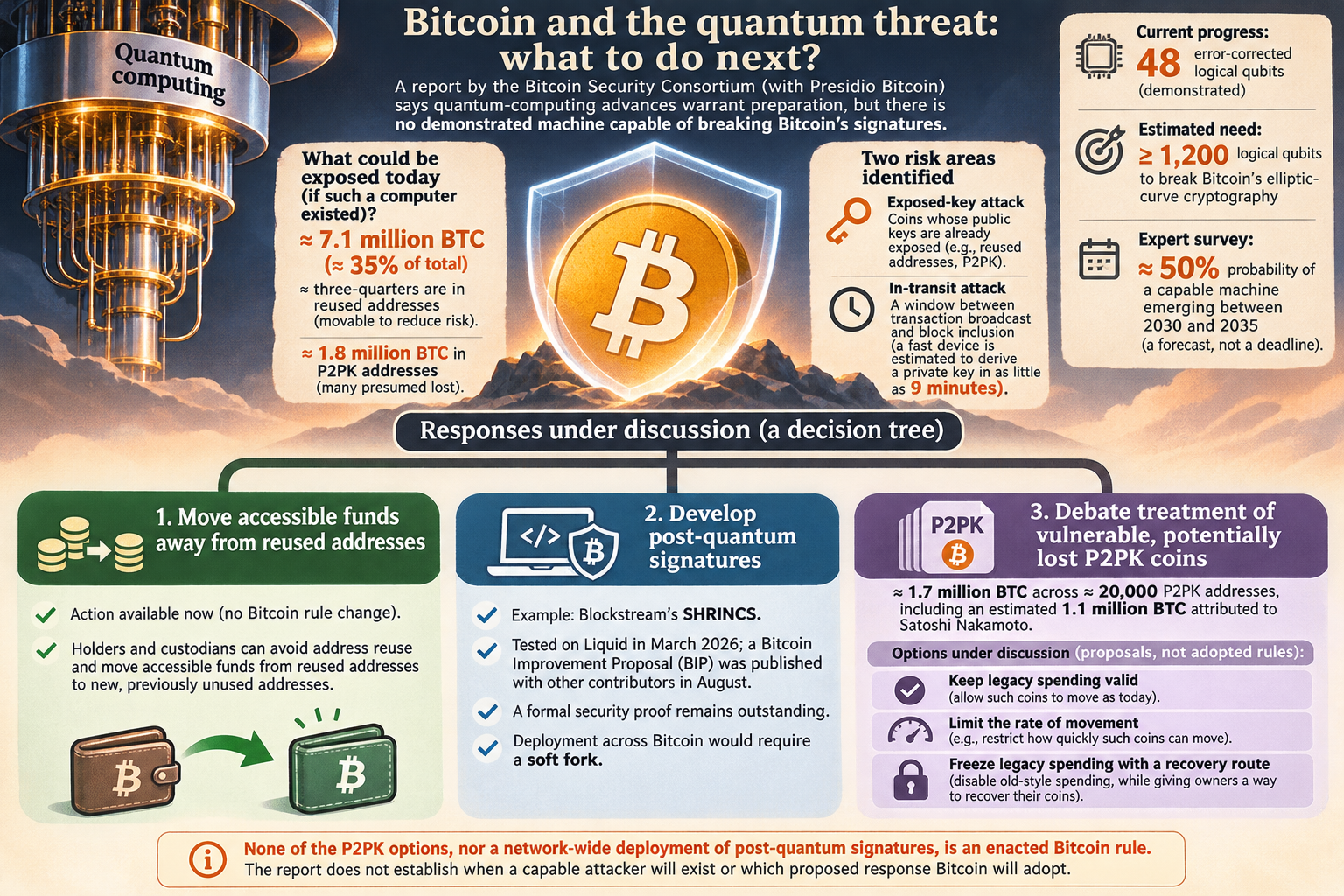
The report distinguishes an action available without a Bitcoin rule change from proposals that remain unresolved. Holders and custodians can avoid address reuse and move accessible funds from reused addresses. Developers are also working on post-quantum signatures: the report says Blockstream tested its SHRINCS proposal on Liquid in March 2026 and published a Bitcoin Improvement Proposal with other contributors in August. A formal security proof remains outstanding, and deployment across Bitcoin would require a soft fork.
For vulnerable P2PK coins that may be inaccessible to their owners, Presidio Bitcoin describes three options under discussion: keep legacy spending valid, limit the rate at which such coins can move, or freeze legacy spending while providing owners a recovery route. None is presented as an enacted Bitcoin rule.
The outlook therefore depends on both quantum hardware progress and Bitcoin’s ability to reduce exposed-key use and agree on any necessary protocol changes. The report does not establish when a capable attacker will exist or which proposed response Bitcoin will adopt.
Source: chaincatcher.com (originally published 2026-11-12 09:18 UTC+8)