Originally reported November 26, 2026, at 12:38:47 UTC+08:00.
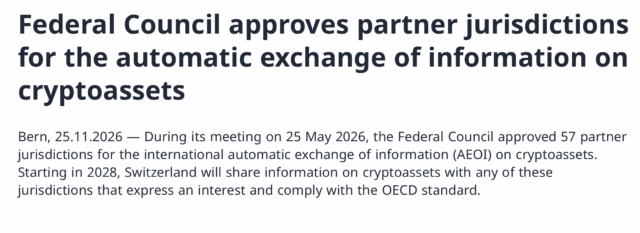
Switzerland’s Federal Council approved 57 potential partner jurisdictions on November 25, 2026, for automatic exchanges of crypto tax information that could begin in 2028. For Bitcoin holders who use Swiss exchanges, the change concerns who may receive their transaction records. It creates no new tax or tax rate.
Switzerland had delayed implementation while lawmakers considered which jurisdictions to include. The State Secretariat for International Finance said implementation could begin no earlier than January 1, 2027. That is distinct from the first international exchange of records: approval of the list does not mean all 57 jurisdictions will receive data in 2028. Each partner must be interested in participating, meet international reporting standards and have an active exchange arrangement.
Which records could reach a foreign tax authority?
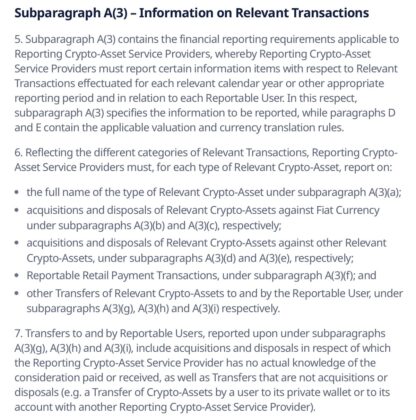
Under the OECD’s Crypto-Asset Reporting Framework (CARF), covered service providers must identify customers’ tax residency and report relevant activity. If a customer is reportable to a partner jurisdiction and its arrangement with Switzerland is active, that jurisdiction’s tax authority could receive information from a Swiss exchange without first investigating the individual account. Identifying details can include the customer’s name, residential address and tax identification number.
The framework covers transactions involving fiat currency, crypto-to-crypto trades and certain digital asset transfers. A Bitcoin sale, a swap of BTC for stablecoins, a transfer between platforms or certain crypto distributions may therefore generate a reportable record. A reportable transaction is not necessarily a taxable one. Domestic law determines whether tax is due.
What self-custody changes
Withdrawing Bitcoin to a private wallet gives the holder control of the assets; it does not erase earlier exchange records. The OECD’s commentary also includes certain transfers from reporting providers to customers’ private wallets. That does not give tax authorities access to private keys or make every subsequent wallet transaction reportable. The reporting obligation rests with covered intermediaries, not the Bitcoin network.
The State Secretariat for International Finance says the objective is “equal treatment of the crypto sector with the traditional financial sector.” Applying that standard also raises questions about accuracy and security. An incorrect residency classification can associate a customer with the wrong jurisdiction, and movements across exchanges and private wallets can make historical costs difficult to reconcile. Protecting records that link identities to crypto activity, and providing a way to correct errors, will matter as Switzerland implements the requirements and activates individual exchange arrangements.